
Biostatistics and epidemiology for biomedical and biological studies
We design, analyze, and interpret biomedical and biological studies, and we tell you how far the data can go.
Each report includes the methods, the code, and the limitations of the analysis.
Services

Study design and advisory
Research question, study design, bias, sample size, and analysis plan.
Includes
- The specific question the study must be able to answer. The design and the analysis follow from it.
- The study type that fits the question: observational or experimental, cross-sectional, cohort, or case-control.
- What can pull the result off course, and the variables that must be controlled so the comparison is fair.
- How many samples are needed to detect the effect you are looking for, and how likely you are to see it if it is real.
- The plan that sets, before the results are inspected, which analyses will be run and how they will be interpreted.

Statistical analysis
Hypothesis tests, regression, ANOVA, survival, multivariate analysis, and missing data.
Includes
- Tests that compare groups or conditions and say whether the observed difference could be due to chance.
- Relate an outcome to the factors that may explain it: linear, logistic, or Poisson regression, depending on the data.
- Compare means across several groups. ANCOVA also adjusts for variables that can confound the comparison.
- Analyses time until an event, such as a relapse, when not every case has reached the end of follow-up.
- Summarizes many variables at once: principal components, factor analysis, or classification.
- When many tests are run, the threshold is adjusted to limit the share of false findings.
- Values that were not collected. You need to know why they are missing before deciding how to handle them.
- Fills the gaps several times in a plausible way and combines the analyses, without dropping incomplete samples.

Population genetics and population omics
GWAS, polygenic risk, Mendelian randomization, pharmacogenomics, and pathogen epidemiology.
Includes
- Searches the whole genome for variants associated with a disease or a trait.
- Summarizes, in one number, the combined effect of many variants on a person's risk.
- Uses genetic variants as an instrument to ask whether a factor causes an outcome, rather than merely being associated with it.
- Studies how genetic variants change the response to a drug.
- Traces the origin and transmission of a pathogen by comparing the genomes of cases.
Why BIAMICS

Bioinformaticians with research experience
We are bioinformaticians with years of research work, so we understand the organism as well as the data. Specialized in microbiology through training and research.

Results checked more than one way
We check results by more than one route and document programs, versions, and databases so the analysis can be repeated.

Transparent about the limits
We tell you what can be concluded from your data and what cannot.

A report ready to deliver
A report with methods, results, figures, and conclusions, in Spanish or in English.
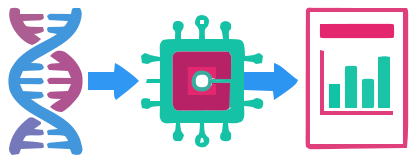
From DNA to the report
If you need it, we also arrange sequencing with collaborating centers.

We are
Reports with documented code, version control, and data aligned with the FAIR principles.
Let's talk about your project
Tell us the question behind your study, the design, and the data you have.